
Open dialogue
Bridge water and economic sectors through open, structured dialogue.
The Forum's Program for enabling water-adjacent economic sectors to collaborate and showcase sustainable water use, across and within industries.
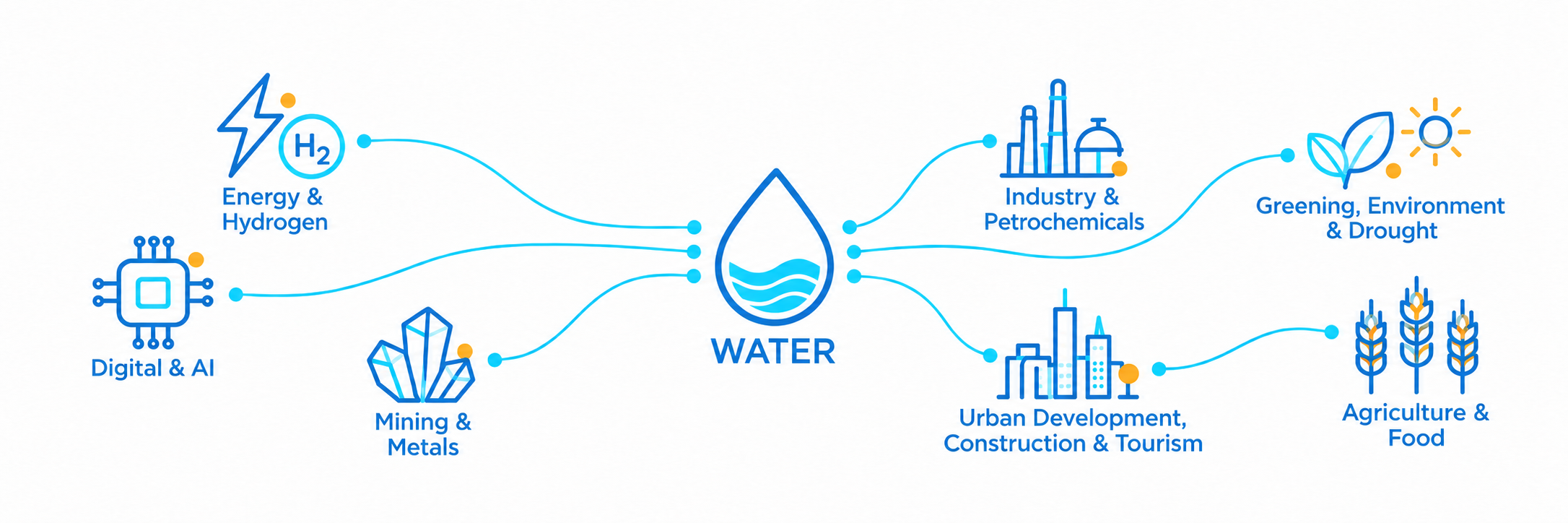
The Intersectoral Program of the 11th World Water Forum is designed to bridge water systems with key economic systems through a structured approach. It addresses cross-cutting challenges while advancing practical and collaborative solutions for action even beyond the Forum.
Led overall by Acwa—the world's largest private water desalination company, a leader in the energy transition, and a first mover in green hydrogen at scale—the program provides a platform for industry leaders, water-sector entities, and international partners to exchange knowledge, document best practices, and identify practical actions that can improve water efficiency, reuse, reliability, and resilience across sectors.
About Acwa
Founded in 2004 in Riyadh, Acwa was built on the belief that affordable power and clean water should be universally accessible. Today, it is the world's largest private water desalination company, a leader in the energy transition, and a pioneer in green hydrogen at scale. Listed on the Saudi Tadawul and backed by Saudi Arabia's Public Investment Fund, Acwa manages a portfolio of 111 assets across 16 countries. With 98 GW of power generation capacity and 9.7 million cubic metres of desalinated-water capacity per day, Acwa can power more than 16 million households and supply clean water to more than 6.8 million households. Through developing, investing in, and operating sustainability infrastructure, Acwa creates value and drives progress for people and the planet.
Acwa operates precisely at the intersection the program is designed to convene—water, power, renewables, sustainability infrastructure, and green hydrogen. Its Saudi roots, global operating footprint, and experience translating complex public–private partnerships into large-scale infrastructure give it the credibility and delivery orientation to connect sectors, mobilize partners, and steer dialogue toward implementable outcomes for Riyadh 2027.
Bridge water and economic sectors through open, structured dialogue.
Discuss shared challenges of efficiency, reuse, reliability, and resilience.
Identify and prioritize practical, high-impact actions to be taken at national and global levels.
Industry-level efforts to sustainably manage and utilize water, and allow for knowledge sharing.
Intersectoral Clusters
Each cluster brings together leading national and international entities to align priorities, exchange expertise, and develop their deliverables for the 11th World Water Forum.
Local: Acwa, NEOM, SEC
International: ExxonMobil, Shell
Local: Aramco Digital, SDAIA
International: Google, IBM, NVIDIA
Local: Aramco Ma'aden JV, MAADEN
International: Rio Tinto, BHP, Vale
Local: SABIC, APC, Tasnee
International: BASF, Dow, Shell
Local: Acwa, NCVC, Saudi Green Initiative
International: UNEP, GEF, WWF
Local: Red Sea Global, Qiddiya, Diriyah Gate
International: UN-Habitat, Bechtel, Vinci
Local: SALIC, Almarai, ARASCO
International: FAO, WFP, World Farmers' Organisation
Governance